
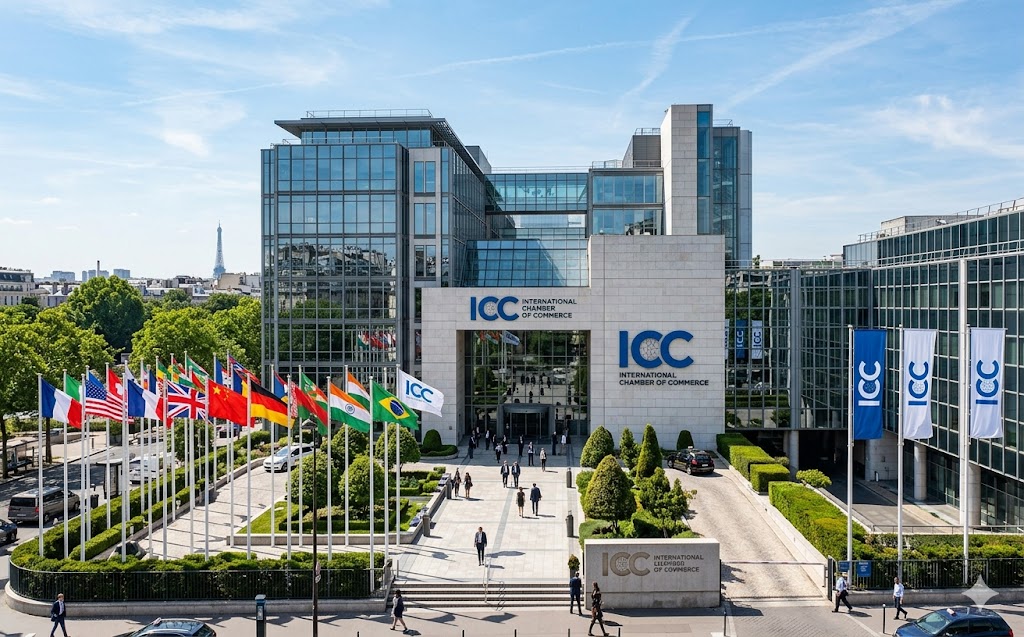
Islamic Trade Finance and the ICC — A Growing Global Recognition
Category: Industry Intelligence · 5 Minute Read
The International Chamber of Commerce is the world’s leading authority on international trade rules and trade finance standards. Its publications, including the Uniform Customs and Practice for Documentary Credits (UCP 600) and the Uniform Rules for Demand Guarantees (URDG 758), govern the majority of international trade finance transactions globally.
For years, a tension existed between ICC standards developed within a conventional finance framework and the requirements of Shariah-compliant trade finance. That tension is diminishing, and rapidly.
The ICC and Islamic Trade Finance
The ICC has progressively recognised the importance of accommodating Islamic finance principles within international trade finance standards. This recognition reflects a commercial reality: a significant and growing proportion of global trade flows through OIC member states, GCC markets, and Southeast Asian economies where Shariah compliance is a material consideration.
The ICC Trade Register represents the global benchmark for trade and supply chain finance, backed by over a decade of aggregated data from leading global banks, and that data increasingly includes Islamic trade finance instruments alongside conventional ones.
Why ICC Recognition Matters
For Islamic trade finance instruments to be accepted by international banks, commodity exchanges, and sovereign counterparties, they must be capable of operating within internationally recognised frameworks. A Kafalah-structured guarantee that cannot be processed under URDG 758 or a Wakalah-based Letter of Credit that is incompatible with UCP 600 would have limited commercial utility.
The growing alignment between ICC standards and Islamic finance principles means that instruments structured under Kafalah and Wakalah frameworks can now operate within the same international documentary and procedural frameworks as their conventional equivalents, while maintaining full Shariah compliance in their underlying contractual structure.
The Market Trajectory
Global Islamic finance assets reached USD 5.98 trillion in 2024, reflecting 21% year-on-year growth. Islamic trade finance is one of the fastest growing segments within this broader market, driven by the expansion of intra-OIC trade, the growing preference for ethical finance among non-Muslim institutional investors, and the progressive mainstreaming of Shariah-compliant instruments in global banking.
What This Means in Practice
For businesses engaging in international trade, the progressive convergence of ICC standards and Islamic finance principles means that choosing a Shariah-compliant trade finance provider no longer requires accepting a compromise on commercial functionality or international acceptability.
At Credit Amanah, our instruments are structured to operate within internationally recognised trade finance frameworks while maintaining complete Shariah integrity, giving our clients the best of both worlds.